Edge IoT Gateway M Specifications
Datasheet. Release 1.9
Remote monitoring of critical infrastructure with edge computing
Overview
Pervasive computing systems are capable of collecting, processing and communicating data, they can adapt to the data’s context and activity. That means, in essence, a network that can understand its surroundings and improve the human experience and quality of life.
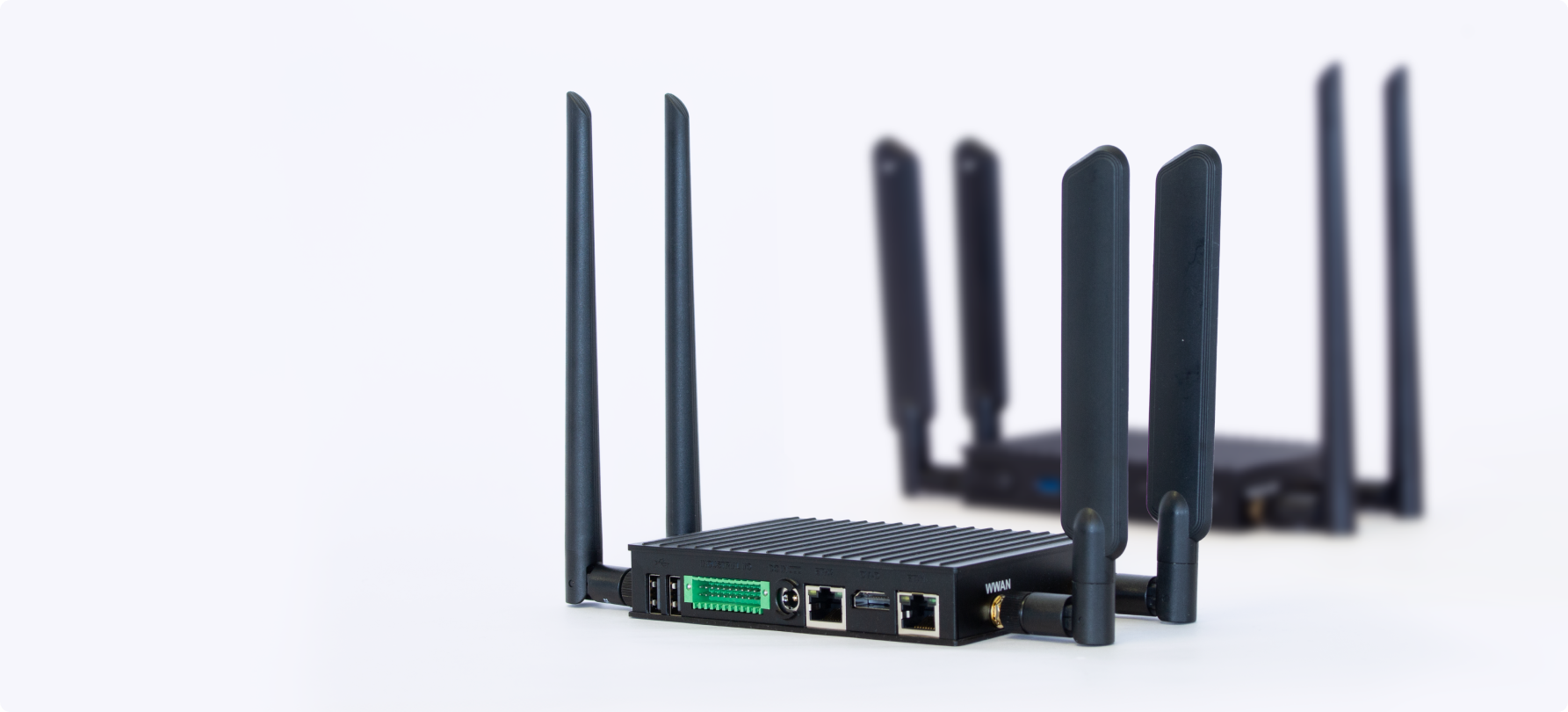
CTHINGS.CO® Edge IoT Gateway (M) connects whatever data customer needs to process directly at the edge, reducing latency and relieving connectivity networks, with full support of Orchestra Platform.
The gateway is based on Linux. It provides tremendous possibilities opening up the entire embedded applications ecosystem. It supports industry standard specifications like mission-critical operation in temperatures ranging between -40°C and 85°C.
The design provides the flexibility needed while still keeping it simple! Based on the concept of modularity, it may operate with many wireless technologies without PCB redesign requirements. As of now, support for major cellular and other radio connectivity standards like Bluetooth 5.x, LTE Cat. 4, Wirepas 2.4GHz Mesh, Wirepas 5G NR+, Wi-Fi 802.11 a/b/g/n/ac, etc. are assured that will open up tremendous possibilities.
To ease deployment of use cases and solutions, the Edge IoT Gateway (M) is designed alongside CTHINGS.CO® Orchestra, a state-of-the-art networking solution making provisioning and maintenance of private networks as simple as a few clicks. Additionally, we open the possibility for curated backend systems including open APIs for connecting external systems, as well as data visualisation capabilities through our interfaces and supported protocols.
Specifications
Hardware Features
Industrially certified hardware for enhanced Edge Computing
Efficient passive cooling & rugged aluminium casing
NXP i.MX8MP Quad-Core ARM® v8 Cortex®-A53 64bit, 1.8 GHz
ARM® Cortex®-M7 real-time co-processor, 800 MHz
AI/ML Neural Processing Unit (NPU) up to 2.3 TOPS
Integrated 2D/3D Vivante GC7000UL GPU
LPDDR4 RAM [1]: 4 GB
Built-in eMMC flash storage [1] up to 32 GB
Up to 2 TB industrial-grade SDXC UHS-I class μSD
Configurable [1] with LTE Cat. 4 or LTE Cat. M1/NB2 cellular mini-PCIe Cards
Configurable [1] with CTHINGS.CO® Wirepas® MESH M.2./mini-PCIe Cards
Configurable [1] with Zigbee/Thread/Wi-Fi/Bluetooth M.2./mini-PCIe Cards
On-board hardware watchdog & support for secure boot
Supports DIN-rail & wall mounting
Operating temperature range: -40 °C to +80 °C
Small and lightweight: 132 x 84 x 25 mm & 550 g
Widely certified, IP20 protection class, RoHS compliant device
Physical Interfaces
1x USB 3.0 SuperSpeed Ports; Type-A
2x USB 2.0 High-Speed Ports; Type-A
2x 1000 Mbps Ethernet port;
1x 802.3af Type-1 PoE; RJ-45 (optional)
Optional [1] 3x RS-232; galvanic isolation
Optional [1] 3x half-duplex RS-485; galvanic isolation
Optional [1] 1x CAN bus port; galvanic isolation
Optional [1] 2x 24 V compliant digital inputs; galvanic isolation
Optional [1] 2x 24 V compliant digital outputs; galvanic isolation
2x general-purpose user-controlled LEDs
1x USB 2.0 Console Serial Interface; USB Type-B Micro
1x Nano-SIM Card
1x M.2 Key-E Expansion Slot with PCIe 3.0 and USB 2.0
1x Mini-PCIe Socket with USB 2.0
1x DVI-D (digital) HDMI-compliant display up to 1080p60
Proprietary connector; add-on boards: LVDS, SDIO, USB, SPI, I2C, GPIOs [1]
Electrical Specification
DC supply voltage: 8 V to 36 V
IEEE 802.3af Type-I Power over Ethernet (PoE) supply [1]
Ultra-low power consumption: typically 5W
EMI/ESD protected device; power supply protection features
FCC, CE, UK CA; EMC EN 55032/5, EN 61000-6-3 certification
EN/UL/IEC 62368-1 safety certification
RoHs compliant
Other features
Connectivity
Full flexibility which allows plug and play exchange of connectivity modules to meet requirements:
Bandwidth overview per connectivity technology:
- Rel. 8 LTE Cat. 4:
LTE-FDD: 150 Mbps (DL); 50 Mbps (UL) LTE-TDD: 130 Mbps (DL); 30 Mbps (UL)
- Rel. 7 HSPA+:
WCDMA: Max. 42 Mbps (DL); Max. 5.76 Mbps (UL)
EDGE: 296kbps (DL), Max. 236.8kbps (UL)
GPRS: 107kbps (DL), Max. 85.6kbps (UL)
- GPS, GLONASS, Galileo, BeiDou/Compass, QZSS,
Cell ID/Wi-Fi positioning
Wi-Fi 6E (a/b/g/n/ac/ax 2.4/5/6 GHz): Max. 2.4 Gbps
Bluetooth Low Energy (BLE) 5.0 / 5.3
Wirepas 2.4 GHz MESH
Wirepas 5G NR+
Zigbee / Thread
Use Cases
The gateways supports vast range of usage across industries. Application examples:
Smart Retail: monitoring stock, goods rotation, sales
Smart Logistics: tracking distribution and transport
Smart Product: embedded intelligence and compute
Industry 4.0: digital retrofitting, enhanced maintenance, remote operations, automation
Smart Metering: remote and wireless data collection
Software Features
Linux® OS Ubuntu® Server Debian® Yocto OpenWRT capable Flexible I/O operations Upgrade Over-The-Air (OTA) Support for CTHINGS.CO® Orchestra
Supported Frequencies
Supported Frequencies
LTE / HSPA+ subsystem [1]
Band name |
Transmit (MHz) |
Receive (MHz) |
LTE-FDD |
LTE-TDD |
UMTS |
GSM |
|---|---|---|---|---|---|---|
IMT (2100) |
1920-1980 |
2110-2170 |
B1 |
— |
B1 |
— |
PCS (1900) |
1850-1910 |
1930-1990 |
B2 |
— |
B2 |
PCS1900 |
DCS (1800) |
1710-1785 |
1805-1880 |
B3 |
— |
B3 |
DCS1800 |
AWS |
1710-1755 |
2110-2155 |
B4 |
— |
B4 |
— |
Cell (850) |
824-849 |
869-894 |
B5 |
— |
B5 |
GSM850 |
UMTS 800 |
830-840 |
875-885 |
— |
— |
B6 |
— |
IMT-E |
2500-2570 |
2620-2690 |
B7 |
— |
— |
— |
EGSM (950) |
880-915 |
925-960 |
B8 |
— |
B8 |
EGSM900 |
700 low A-C |
699-716 |
729-746 |
B12 |
— |
— |
— |
700 upper C |
777-787 |
746-756 |
B13 |
— |
— |
— |
700 upper D |
788-798 |
758-768 |
B14 |
— |
— |
— |
B18 |
815-830 |
860-875 |
B18 |
— |
— |
— |
B19 |
830-845 |
875-890 |
B19 |
— |
— |
— |
EU800 |
832-862 |
791-821 |
B20 |
— |
— |
— |
PCS + G |
1850-1915 |
1930-1995 |
B25 |
— |
— |
— |
B26 |
814-849 |
859-894 |
B26 |
— |
— |
— |
700 APAC |
703-748 |
758-803 |
B28 |
— |
— |
— |
IMT-E (B38) |
2570-2620 |
2570-2620 |
— |
B38 |
— |
— |
S-band |
2300-2400 |
2300-2400 |
— |
B40 |
— |
— |
BRS (US) |
2555-2655 |
2555-2655 |
— |
B41 |
— |
— |
B66 |
1710-1780 |
1710-1780 |
B66 |
— |
— |
— |
B71 |
663-698 |
617-652 |
B71 |
— |
— |
— |
LTE Cat. M1 / Cat. NB1 / Cat. NB2 / EGPRS subsystem [1]
Band name |
Transmit (MHz) |
Receive (MHz) |
LTE-FDD |
GSM |
|---|---|---|---|---|
IMT (2100) |
1920-1980 |
2110-2170 |
B1 |
— |
PCS (1900) |
1850-1910 |
1930-1990 |
B2 |
PCS1900 |
DCS (1800) |
1710-1785 |
1805-1880 |
B3 |
DCS1800 |
AWS |
1710-1755 |
2110-2155 |
B4 |
— |
Cell (850) |
824-849 |
869-894 |
B5 |
GSM850 |
EGSM (950) |
880-915 |
925-960 |
B8 |
EGSM900 |
700 lower A-C |
699-716 |
729-746 |
B12 |
— |
700 upper C |
777-787 |
746-756 |
B13 |
— |
B18 |
815-830 |
860-875 |
B18 |
— |
B19 |
830-845 |
875-890 |
B19 |
— |
EU800 |
832-862 |
791-821 |
B20 |
— |
PCS + G |
1850-1915 |
1930-1995 |
B25 |
— |
B26 |
814-849 |
859-894 |
B26 [2] |
— |
B27 |
807-824 |
852-869 |
B27 [2] |
— |
700 APAC |
703-748 |
758-803 |
B28 |
— |
B31 |
452.5-457.5 |
462.5-467.5 |
B31 [1] |
— |
B66 |
1710-1780 |
2110-2180 |
B66 |
— |
B71 |
663-698 |
617-652 |
B71 [3] |
— |
B72 |
451-456 |
461-466 |
B72 [1] |
— |
B73 |
450-455 |
460-465 |
B73 [1] |
— |
B85 |
698-716 |
728-746 |
B85 |
— |
LTE-FDD RF bandwidth
LTE Cat. M1: 1.4 MHz
LTE Cat. NB2: 200 kHz
Maximum throughput
LTE Cat. M1: 588 kbps (DL); 1119 kbps (UL)
LTE Cat. NB2: 127 kbps (DL); 158.5 kbps (UL)
EDGE: 296 kbps (DL); 236.8 kbps (UL)
GPRS: 107 kbps (DL); 85.6 kbps (UL)
Transmit power class:
LTE-FDD bands: Class 5 (21 dBm +1.7/-3 dB) [1]
GSM850: Class 4 (33 dBm ± 2 dB)
EGSM900: Class 4 (33 dBm ± 2 dB)
DCS1800: Class 1 (30 dBm ± 2 dB)
PCS1900: Class 1 (30 dBm ± 2 dB)
GNSS subsystem [1]
Type |
Frequency (MHz) |
GNSS acquisition performance: |
value |
|---|---|---|---|
GPS |
1575.42 ± 1.023 (L1) |
Cold start (open sky) |
18.9 seconds typical |
Galileo |
1575.42 ± 2.046 (E1) |
Warm start (open sky) |
1.5 seconds typical |
QZSS |
1575.42 (L1) |
Hot start (open sky) |
1.1 seconds typical |
GLONASS |
1597.5-1605.8 |
CEP-50 accuracy (open sky) |
1 metre typical |
BeiDou / COMPASS |
1561.098 ± 2.046 |
Capabilities
Wireless connectivity via: LTE, M1, NB-IoT, 3G, EGPRS, Wi-Fi 6E, BLE 5.3, Wirepas 2.4/5G, Zigbee, Thread
Extensive Connectivity
Rich Software Ecosystem Linux® OS (Yocto® and Debian®), Mainline Linux, FreeRTOS®, Ubuntu® Server, OpenWRT
Vast IoT Protocol Suite Native support of modern IoT Protocols: i.e. MQTT/-SN, Modbus RTU, Modbus TCP, etc.
Localisation GPS, GLONASS, Galileo, BeiDou, COMPASS, Cell ID/Wi-Fi positioning, Wirepas MESH
OA&M Linux OS Remote operations, administration, and maintenance
RESTful Ease of data access via REST Web APIs
Interfaces Vast integration of sensors network on common data bus: i.e. USB 3.0, 2x USB 2.0, CAN bus, up to 3x RS485 or RS232, industrial digital I/O, etc.
MPU Multipurpose computing, hybrid data processing in edge, public or private cloud
Certifications
The CTHINGS.CO® Edge IoT Gateway is CE Class-A & EU RoHS directive compliant. The device has been tested to meet the following electromagnetic compatibility standards:
Electromagnetic emissions
Conducted emission: EN 55022, EN 55014-1, EN 55011 Radiated emission up to 6 GHz Harmonic current emission: EN 61000-3-2 Voltage fluctuations and flicker: EN 61000-3-3
Immunity to electromagnetic interference (EMI):
Electrostatic discharge (ESD) immunity: EN 61000-4-2 Radiated electromagnetic field immunity: EN 61000-4-3 Electrical fast transient / burst immunity: EN 61000-4-4 Surge immunity: EN 61000-4-5 Conducted disturbance immunity: EN 61000-4-6 Power frequency magnetic field immunity: EN 61000-4-8 Pulse magnetic field immunity: EN 61000-4-9 Voltage dips & short interruptions: EN 61000-4-11
External appearance
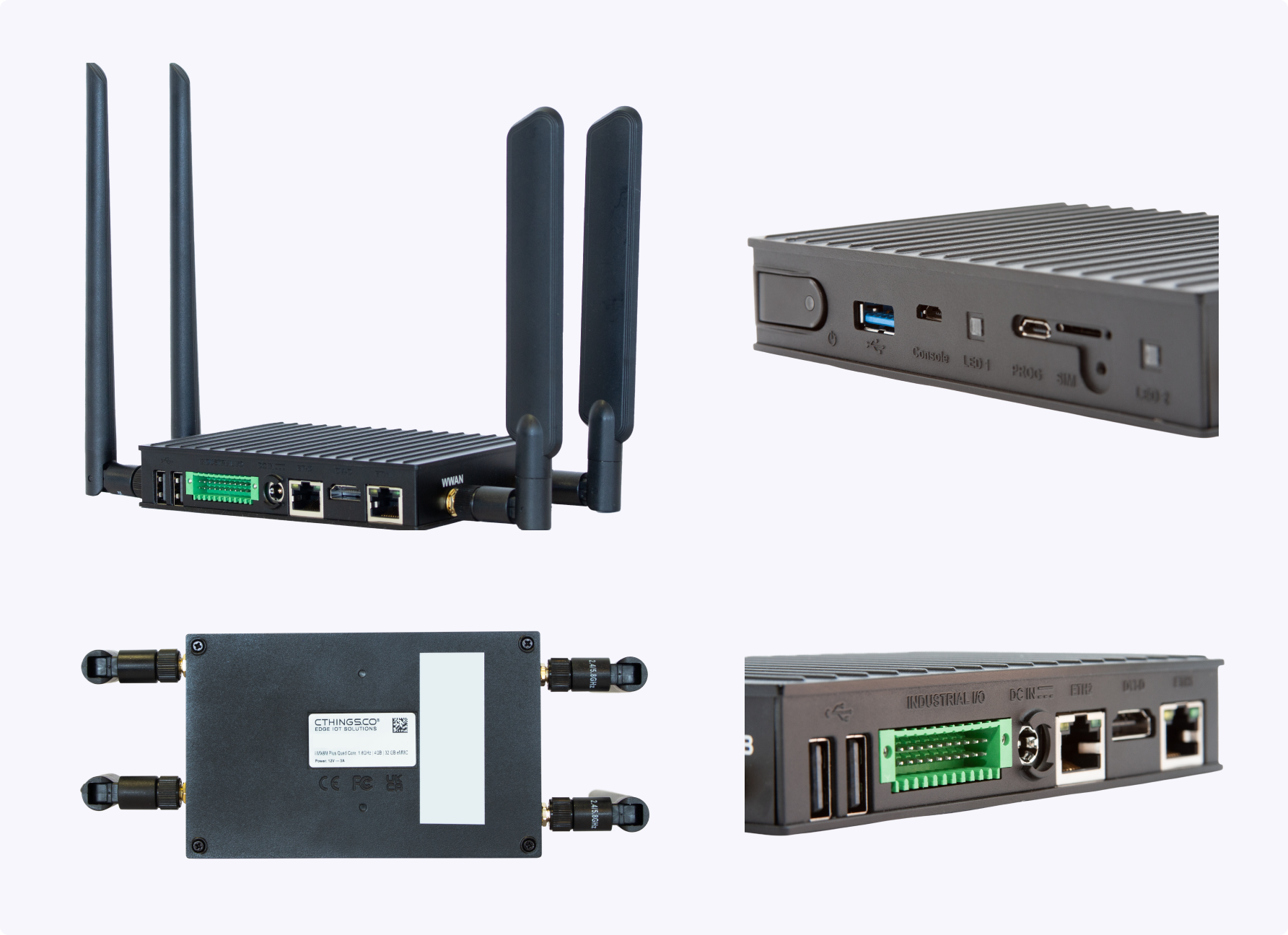
Edge IoT Gateway M with Antennas: 2x LTE + 1x Wi-Fi + 1x BT
Start your digital transformation journey
Footnotes